What to check before you spend five figures on a machine
Most people buying their first laser or IPL system are shown a specification sheet and a finance quote. Almost nobody is shown the paperwork that decides whether the machine can lawfully be sold to you, whether your insurer will cover you, and whether your council will let you switch it on. This page is that missing conversation, written plainly, with the rules named so you can check them yourself.
Device classification
MHRA registration
UK Responsible Person
CE and UKCA dates
Laser Protection Adviser
Local rules
Treatment protocols
Eye protection
Core of Knowledge
Treatment licensing
Criminal liability
Ofqual and CPD
Company checks
Finance
Written by a UK Responsible Person for medical devices, not by a salesperson
We sell machines, so read this with that in mind. Everything below is checkable against the sources listed at the foot of the page. Where the honest answer is the law does not say, we have said so rather than dressing up good practice as a legal requirement.
Start here
Is it a medical device or a cosmetic device?
This single question decides which rules apply to your purchase, and a surprising number of suppliers cannot answer it about their own stock.
Under the Medical Devices Regulations 2002, a product is a medical device if the manufacturer intends it to be used for diagnosing, preventing, monitoring, treating or alleviating disease or injury, or for modifying the anatomy or a physiological process. The decisive word is intends. It is the manufacturer’s stated purpose, set out in the labelling, the instructions for use and the marketing, that determines device status, not the technology inside the box, and not what you personally plan to treat.
1
If it is a medical device
It must carry a valid conformity marking, be registered with the MHRA before it is placed on the Great Britain market, and, if the manufacturer sits outside the UK, have a UK Responsible Person appointed.
An energy-delivering laser or IPL is normally Class IIa or IIb. Neither can be self-certified. A third party, an approved body in Great Britain or a notified body in the EU, has to assess it and issue a certificate.
2
If it is a cosmetic-only device
There is currently no medical device registration requirement in Great Britain for a product with no medical intended purpose. Cavitation, radiofrequency, EMS and hydro facial systems usually sit here.
That is a different legal classification, not a lesser machine. But it does mean nobody has assessed it against medical device law, and you should not let anyone imply otherwise.
3
The honest grey area
The Government has said it intends to bring products without a medical purpose, naming cosmetic lasers and IPL equipment specifically, into the Great Britain regime. As at August 2026 that has not been given legal effect and no date has been published.
In Northern Ireland the position is already different, because EU rules apply there.
A worked example, because this is easier to see than to explain
We asked the MHRA to look at a specific aesthetic device. The answer was that the claims made for it centred on skin tightening, rejuvenation and reducing body fat, that a compliance manager would not classify those as medical conditions, and that the product would therefore not be a medical device under the UK Medical Devices Regulations 2002.
The same reply went on to say the product would meet the definition under the EU Medical Devices Regulation 2017/745, Annex XVI, which expressly covers equipment for reducing or destroying fat tissue, and high intensity light emitting equipment, including lasers and intense pulsed light, for skin resurfacing, tattoo removal, hair removal or other skin treatment.
So a machine can be genuinely CE marked and genuinely not a Great Britain medical device at the same time. The mark tells you it satisfied a European route. It does not tell you which side of the UK line the product sits, and it is not a substitute for asking. The MHRA is also careful to say that its views on interpretation are its best judgement rather than a definitive statement of law. Only a court can give that.
Medical devices and cosmetic devices sit side by side in a showroom and look much the same. The difference is in the paperwork, not the panel.
Ask the supplier, in writing, one question: is this machine a medical device, and if so what is its class? If the answer is vague, or if the answer is yes but there is no certificate and no registration entry, that is your answer about the supplier as well as the machine.
MHRA registration
What registration means, and what it very much does not
This is the most misused phrase in the industry, so it is worth being precise.
Registering a device with the MHRA is a notification. The manufacturer, or their UK Responsible Person, tells the regulator what they are placing on the market before they place it. The MHRA does not test the machine, inspect it, approve it or endorse it.
The MHRA says so itself, in the plainest terms: registration does not represent any form of accreditation, certification, approval or endorsement, and suppliers are not permitted to claim that it does, or to use MHRA logos in their marketing.
So “MHRA approved” means nothing
There is no such status. Neither is “MHRA certified”. If a supplier uses either phrase, they are describing something that does not exist, and breaching advertising rules while they do it.
“MHRA registered” does mean something
It means the device has been notified to the regulator so it can lawfully be placed on the market, and that somebody in the UK is accountable for it. That is worth having. It is just not a quality award.
You can check it yourself, free
The MHRA publishes a Public Access Registration Database. It lists the manufacturer, the device types, the brand names and the UK Responsible Person. Search it yourself rather than accepting a screenshot from a supplier.
Registration is per market, not per unit
A registration covers a manufacturer’s device category. It does not certify the individual machine sitting in a warehouse, and it says nothing about how that unit has been stored, refurbished or serviced.
UK Responsible Person
Who is legally on the hook for your machine?
If the manufacturer is outside the UK, and for most aesthetic lasers they are, somebody in the UK has to carry their obligations. That person is the UK Responsible Person.
A manufacturer based outside the UK must appoint a single UK Responsible Person before their device can be placed on the Great Britain market, and that appointment is a legal contract, not a courtesy title. The regulations set out what the UKRP has to do.
Make sure the declaration of conformity and technical documentation exist, and that the right conformity assessment has been done
Keep the declaration, the technical file and any certificate available for the MHRA to inspect
Give the MHRA whatever information it asks for to demonstrate the device conforms
Provide samples or access to the device, or pass the request to the manufacturer
Cooperate with the MHRA on any corrective action to remove or reduce a risk
Pass on immediately any complaint or suspected incident reported by a practitioner, patient or user
End the relationship and tell the MHRA if the manufacturer will not meet its obligations
A UK Responsible Person can be prosecuted as the person who placed the device on the market. That is the point of the role. If nobody in the UK holds it, nobody in the UK carries those duties, and the gap tends to become visible at the worst possible moment.
Conformity marking
CE and UKCA, and the dates you need in your diary
Great Britain still accepts CE marked medical devices, but not indefinitely, and the deadline depends on which European rules the certificate was issued under.
Certificate route
Can be placed on the GB market until
EU Medical Devices Directive or Active Implantable Directive
The earlier of the certificate expiry date or 30 June 2028
EU Medical Devices Regulation (MDR)
30 June 2030
UKCA marked, assessed by a UK approved body
No end date
Two points that get muddled. First, these dates govern placing a device on the market, meaning the first supply of it in Great Britain. Nothing in the rules requires you to stop using a machine you already own lawfully when the date passes. Second, a consultation on recognising CE marked devices indefinitely ran in early 2026 and closed without a published outcome. Until that changes, the dates above are the dates that apply. Anyone telling you they have already been extended is ahead of the published record.
Ask which route the certificate took
An MDD certificate and an MDR certificate look similar on a wall. They give you very different amounts of runway. Ask for the certificate, and look at the issuing body and the expiry date.
Ask to see it before you pay
A declaration of conformity naming your exact model, and the approved or notified body certificate with its number and expiry. Not a brochure. Not a photograph of a plaque.
The certificate trap, and this one catches almost everybody
When you ask an overseas manufacturer for “the certificate”, what usually arrives is an EMC or electrical safety test report, a RoHS certificate, or an FDA test report. They look official. They are properly produced documents. They are not what you need.
When we submitted exactly those documents to register a device, the MHRA’s answer was that registration requires a certificate demonstrating the device has achieved UK Approved Body or Notified Body certification, and that electrical safety standards and an FDA test report are not suitable for that purpose.
Electrical safety is not conformity assessment. FDA clearance is not a UK or European route. RoHS is about hazardous substances. If a supplier offers any of those when you ask for the conformity certificate, either they do not have one or they do not understand the difference. Neither is a good sign.
The big one
Buying direct from the manufacturer
The saving is real and so is the exposure. Here is what actually shifts onto you.
It is worth separating what the law says from what experience says, because the two get blurred in this argument.
What the law says
No one may place a medical device on the Great Britain market unless they are established in Great Britain and, where the manufacturer is overseas, a UK Responsible Person has been appointed and the device registered before it is placed on the market.
A GB importer must tell the manufacturer or UKRP that they intend to import, so that the importer’s details can be given to the MHRA.
Labelling and instructions for use must be in English. That is a legal requirement, not a preference.
Enforcement is not limited to manufacturers. MHRA notices can be issued to others in the supply chain, and breaching the regulations is a criminal offence.
In August 2026 the MHRA told organisations holding devices supplied without proper conformity markings to stop using them immediately and quarantine remaining stock. That is the practical shape of getting this wrong.
What experience says
Insurance. Malpractice and public liability cover commonly depends on equipment being lawfully supplied, properly marked and used as the manufacturer instructs. Ask your broker, in writing, naming the exact make and model, before you buy rather than after a claim.
Servicing and parts. Handpieces, flashlamps, filters and cooling components are the things that fail. Without a UK party in the chain, calibration and warranty work mean shipping the unit abroad, and consumable supply gets fragile.
Safety notices. Field safety notices are sent to known customers. If your purchase is invisible to the UK chain, you may simply never be told.
Resale. A machine that cannot be shown to have been lawfully placed on the GB market is hard to sell on, because the next buyer’s checks will find the same gap.
Litigation. In a burn or scarring claim, “no valid conformity assessment and no UK Responsible Person” is a very difficult sentence to stand next to.
Replica machines are a real problem, not a scare story
Where a brand becomes well known, copies follow. We have seen replica and counterfeit versions of recognised aesthetic devices offered into the UK market with no certification behind them, and we have seen the injuries that follow. A convincing badge, a familiar model name and a plausible brochure cost a counterfeiter almost nothing.
This is the practical reason to verify the manufacturer on the MHRA’s public database yourself rather than trusting the branding on the front panel. If you believe a non-compliant or counterfeit device is being sold in the UK, the MHRA asks that you report it to its devices compliance team, and that any adverse incident is reported through the Yellow Card scheme so it can be investigated.
The legal position
The laws that actually get breached, and by whom
People assume the worst case is a stern letter. It is not. Breaches of the medical device rules are criminal offences, and the liability reaches further down the chain than most buyers expect.
The Medical Devices Regulations 2002 were amended for Great Britain by the Medical Devices (Amendment etc.) (EU Exit) Regulations 2020, SI 2020/1478. They are designated as safety regulations under the Consumer Protection Act 1987. That designation is what gives them teeth.
1
Criminal liability
Breaching a safety regulation is an offence under section 12 of the Consumer Protection Act 1987, headed “Offences against the safety regulations”.
Section 12(3) is the one that bites hardest here: it is an offence to contravene a provision requiring information to be given “by means of a mark or otherwise”, which is labelling and conformity marking.
On summary conviction the section provides for imprisonment for up to six months, a fine, or both.
2
Seizure
The MHRA has investigatory powers, including the power to seize goods, under Schedule 5 to the Consumer Rights Act 2015, headed “Investigatory powers etc.”
In practice that means a non-compliant machine can be taken out of your treatment room. In August 2026 the MHRA also told organisations holding devices supplied without proper conformity markings to stop using them immediately and quarantine remaining stock.
3
It reaches you, not just the seller
MHRA enforcement notices are not limited to manufacturers. They can be issued to others in the marketing and supply chain.
Where a device is placed on the UK market without proper conformity assessment, the importer or the person who placed it on the market is liable. If you import a machine yourself, that person is you.
The four regulations that come up again and again
Regulation
What it covers
How it gets breached in practice
Regulation 8
Essential requirements for general medical devices
A label that does not clearly bear the manufacturer’s name and address, or the year of manufacture
Regulation 10
CE marking of general medical devices
A CE mark with no notified body or UK approved body number beside it, where one is required
Regulation 17
Manufacturers and conformity assessment procedures
A device placed on the UK market without the conformity assessment its class requires, the importer or person who placed it on the market carries the liability
Regulation 19
Registration of persons placing devices on the market
A manufacturer of a Class IIb device that is simply not registered with the MHRA
The sentence every buyer should read twice. An MHRA compliance officer put it like this: once a new device has been supplied where it has no certification, that cannot be undone by the supplier changing any labels or other documents, because the illegal supply has already taken place and the offence has been committed. A supplier who promises to “sort the paperwork out afterwards” is describing something that is not possible.
And a trap almost nobody sees coming: your own paperwork can reclassify the machine
In an investigation we are aware of, an MHRA compliance officer inspected a clinic’s client consent form for a laser training course. It listed treatments for vascular lesions and active acne. The officer’s finding was that both are medical claims, and that such claims automatically make the device a medical device, which then requires certification from a notified body or a UK approved body. The machine in question had neither.
The same officer listed the claims that make an aesthetic device a medical device: acne, rosacea, thread and spider veins, varicose veins, vein collapsing, and fungal nails.
So the machine you bought as a cosmetic device can become, in law, a medical device because of what your own website, price list, training materials or consent forms say it treats, and at that point it needs certification it may never have had. Wording is not marketing decoration here. It is classification.
Who does what
UKRP, LPA, LPS, Local Rules and the EMP
Ask five suppliers what you legally need and you will get five answers. Here is the actual position, separated into law and good practice.
1
UK Responsible Person (UKRP)
Sits with the machine, before it ever reaches you. Appointed by an overseas manufacturer, and legally accountable for that manufacturer’s obligations in the UK: holding the declaration of conformity and technical file for the MHRA, cooperating on corrective action, passing complaints and suspected incidents straight back to the manufacturer, and walking away and telling the MHRA if the manufacturer will not comply.
A UKRP can be prosecuted as the person who placed the device on the market. This is a legal appointment under the Medical Devices Regulations 2002, not a safety adviser, and nothing to do with your treatment room.
You do not appoint one. You check that one exists, and that the machine you are buying is registered under it.
2
Laser Protection Adviser (LPA)
Your safety adviser, usually external. They advise on room design and risk assessment, define the controlled area, specify protective eyewear, oversee commissioning, and make sure suitable local rules are drafted.
There is no Great Britain-wide law requiring a private aesthetic clinic to appoint one. The MHRA calls it good practice. It becomes compulsory through registration or licensing. See the next section.
3
Laser Protection Supervisor (LPS)
Somebody inside your clinic who supervises day-to-day use, supervises the operators, and makes sure the local rules are actually followed. Often the owner. A deputy is needed for when they are away.
A professional standard rather than a general legal duty, but a sensible one, and named in the Northern Ireland standards. In a small clinic this is usually you.
4
Local Rules
The written safety document: your safety structure, authorised users, key control, the controlled area, safe working methods, eyewear, pre-use checks and what to do when something goes wrong.
No Great Britain statute names them. The MHRA treats them as the way you comply with your general duty under the Health and Safety at Work etc. Act 1974. In Wales and Northern Ireland they are effectively compulsory.
5
Expert Medical Practitioner (EMP)
A GMC-registered doctor who writes and signs your Treatment Protocol, the clinical document covering each treatment you offer, consent, contraindications, photosensitive medication, managing adverse reactions and duties under the Equality Act 2010. Sometimes written EMP/ERHP.
This is a clinical role, not a safety one. Your LPA advises on the laser. Your EMP stands behind the treatment. They are two different people doing two different jobs, and a good clinic has both.
The one-line version. The UKRP answers for the machine to the regulator. The LPA makes your room and your equipment safe to use. The LPS makes sure that actually happens every day. The Local Rules are where the LPA’s advice is written down. The EMP is the doctor behind the treatment itself. Five different jobs, and only two of them are yours to appoint.
Whether you need an EMP depends on who is asking
Wales requires treatment protocols signed by a relevant practising GMC-registered professional before Healthcare Inspectorate Wales will accept a registration. Northern Ireland requires a professional protocol under its independent healthcare regulations. Many English councils that operate special treatment licensing expect a protocol issued under the authority of an expert medical practitioner.
But not all of them. One London borough told an applicant in writing this month that employing an EMP is not in its licence conditions, while recommending she ask her insurer and her LPA, and keep a list of EMPs available in case of an accident. That is a fair illustration of the whole page: the requirement varies by council, and the only reliable answer is the one your own licensing officer gives you in writing.
Two practical points worth knowing before you decide. A treatment protocol cannot be back-dated. It protects you from the date it is issued, not retrospectively. And an independent doctor is unlikely to make themselves available after an adverse incident if they were not already retained before it, so “keep a list of names” is thinner protection than it sounds.
What the law does clearly require of an employer
The Control of Artificial Optical Radiation at Work Regulations 2010 apply across Great Britain wherever there is a foreseeable risk to eyes or skin. They require a suitable and sufficient risk assessment that expressly considers any Class 3B or Class 4 laser in use; recording the significant findings; eliminating or reducing risk so far as reasonably practicable; where exposure could exceed the exposure limits, demarcating and restricting access to the area and signing it; providing information and training including the proper use of protective eyewear; and health surveillance where the assessment shows a risk of adverse skin effects.
How to check an LPA is actually qualified
There is no statutory register of Laser Protection Advisers and no legal definition of the competence required. In practice the MHRA points to two certification routes, and both publish their certificate holders: RPA2000 and the Association of Laser Safety Professionals (ALSP). If someone offers you LPA services, ask which certification they hold and check the list. It takes a minute.
The laser safety and treatment protocol sections of this page were informed by the guidance of Dr Godfrey Town, who has been an RPA2000-certified Laser Protection Adviser since 2003 and holds a PhD in laser physics. He is the Laser Protection Adviser who supports Skintastic and the clinics we supply, and every system we sell sits inside his governance framework.
He is also an expert witness in laser personal injury and negligence cases, which is a useful perspective to have in the room when you are deciding how much paperwork is enough. You can verify any LPA, including him, on the RPA2000 list of certificate holders.
One acronym, two meanings, and the confusion is entirely understandable. In laser and IPL work, EMP means Expert Medical Practitioner, as above. A Medical Physics Expert is something else altogether: a genuine statutory appointment, but only for ionising radiation under the Ionising Radiation (Medical Exposure) Regulations 2017. Lasers and IPL are non-ionising and sit outside those rules entirely. If someone tells you that you need “an EMP”, ask them to spell out which one they mean, because the person you need to find is completely different in each case.
Labels and signs
What a properly labelled machine looks like
Before you look at the specification sheet, walk round the back of the machine. The labels tell you more about a supplier than the brochure does.
Laser labelling is set by BS EN 60825-1:2014+A11:2021, Safety of laser products. It is worth knowing what should be there, because a missing or vague label is often the first visible sign that the paperwork behind the machine is missing too.
The rating plate, and the three things it must tell you
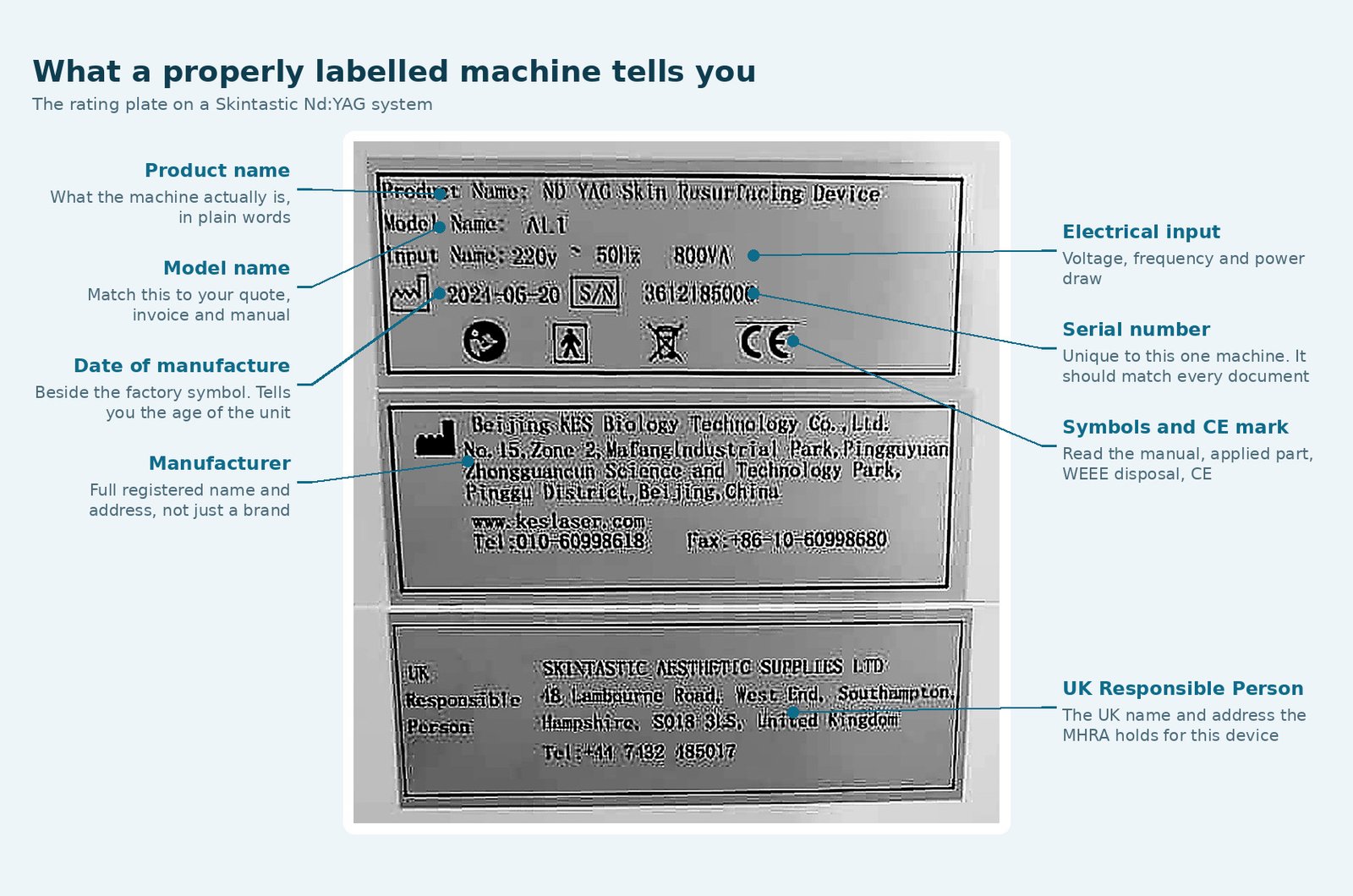
The rear of one of our machines, with each field labelled. Three separate plates: the device itself, the manufacturer, and the UK Responsible Person. If any one of the three is missing, ask why. On a phone, tap the picture to open it full size.
1
The device plate
Product name, model name, electrical input, date of manufacture and serial number, with the conformity marking. On a medical device the CE or UKCA mark should be accompanied by the approved or notified body number where one is required.
The serial number is the one you will quote for servicing, insurance, your Local Rules and any adverse incident report. Photograph it on day one.
2
The manufacturer plate
The name and full address of the manufacturer. Not a brand name, not a trading style, and not just a country. The Medical Devices Regulations 2002 treat a label that does not clearly bear the manufacturer’s name and address, or the year of manufacture, as a breach.
This is also how you check the manufacturer against the MHRA’s public database rather than taking the badge on the front at face value.
3
The UK Responsible Person plate
Where the manufacturer sits outside the UK, the UK Responsible Person’s name and address. On the machine above that is us, because we hold that appointment for the manufacturer.
If a machine has come from overseas and there is no UKRP anywhere on it or in the paperwork, that is the single most useful thing you will learn all day.
The yellow laser warning labels
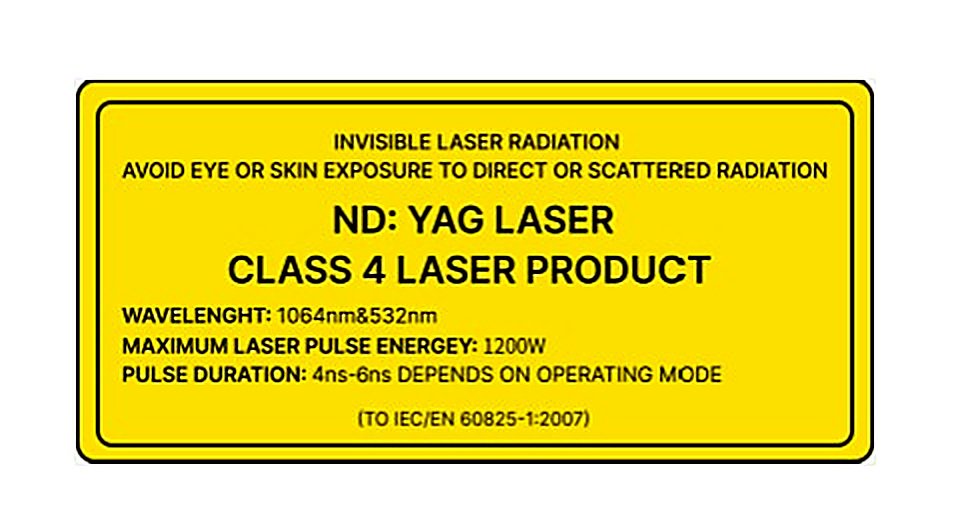
A Class 4 explanatory label: black on yellow, naming the laser type, the class, and the wavelengths, energy and pulse duration it actually emits.
Under section 7.7 of the standard, every Class 4 laser product must carry two things: a warning label, which is the yellow triangular hazard symbol, and an explanatory label in black on yellow bearing words to the effect of:
DANGER. LASER RADIATION. AVOID EYE OR SKIN EXPOSURE TO DIRECT OR SCATTERED RADIATION. CLASS 4 LASER PRODUCT.
The exact wording is recommended rather than mandatory, and other wording carrying the same meaning may be used, which is why you will see slight variations between manufacturers. What should not vary is that the label exists, that it is on the machine, and that it states the class.
The aperture label, and the numbers that should appear somewhere
At the aperture
A separate label goes on or close to the beam aperture under section 7.8, reading something like LASER APERTURE, or APERTURE FOR LASER RADIATION, or AVOID EXPOSURE, LASER RADIATION IS EMITTED FROM THIS APERTURE.
On a platform system with several handpieces, check each one. Missing wavelength markings on a single tip is a real and common gap.
The numbers
Section 8.1 requires the information for the user to state, in appropriate units: the wavelength in nm, the beam divergence, the pulse duration and repetition rate, and the maximum power or energy output.
These are the same numbers your Laser Protection Adviser needs to specify your eyewear. If the supplier cannot produce them, you have found a problem that goes well beyond a sticker.
The signs that go on the door
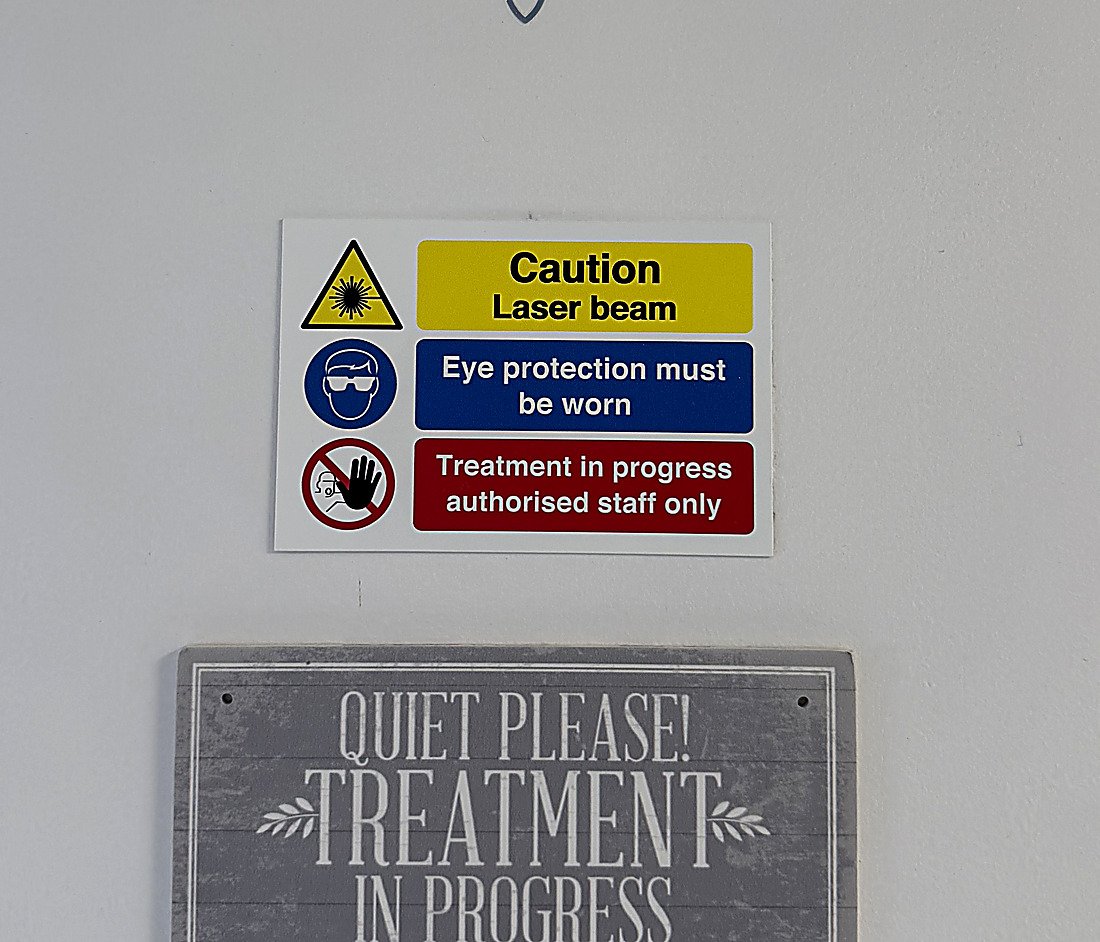
The signs outside our own treatment room. Yellow to warn, blue to instruct, red to prohibit, plus a plain reminder that a treatment is under way.
The machine labels are the manufacturer’s job. The signs on your door are yours. A controlled area sign normally carries three messages together, because they do three different jobs.
Warn
CAUTION. CONTROLLED AREA. LASER / IPL IN USE. Yellow, with the laser hazard triangle. This is the one that tells somebody there is a hazard on the other side of the door.
Prohibit
NO UNAUTHORISED ACCESS. KNOCK AND WAIT. Red. Knock and wait matters more than it sounds, because it gives the operator time to stop firing and say come in.
Instruct
LASER / IPL EYEWEAR MUST BE WORN. Blue. It applies to everybody inside the controlled area, not just the person holding the handpiece.
Clinics commonly add a no eating, drinking or smoking sign for the treatment area as well. It is not laser-specific, but it belongs in a room with flammable preparations, sharps and expensive optics in it.
The rule people forget. The warning sign goes up when the machine is in use and comes down, or gets covered, when it is not. A sign that lives on the door permanently stops being a warning and becomes wallpaper, and an inspector will say so.
A five-minute check that is worth doing before you pay. Ask for clear photographs of the rear plates and every warning label on the machine and its handpieces. Read the serial number, the manufacturer address and the UK Responsible Person. Then look the manufacturer up yourself. A supplier with nothing to hide will send the photographs the same day.
The room
What actually makes a treatment room laser safe
Buyers plan for the machine and forget the room. Your Laser Protection Adviser will not, and neither will a licensing officer.
This is drawn from the site audit a certificated LPA carries out before issuing your Local Rules and Risk Assessment. It is worth reading before you choose which room the machine goes in, because some of it is expensive to fix afterwards.
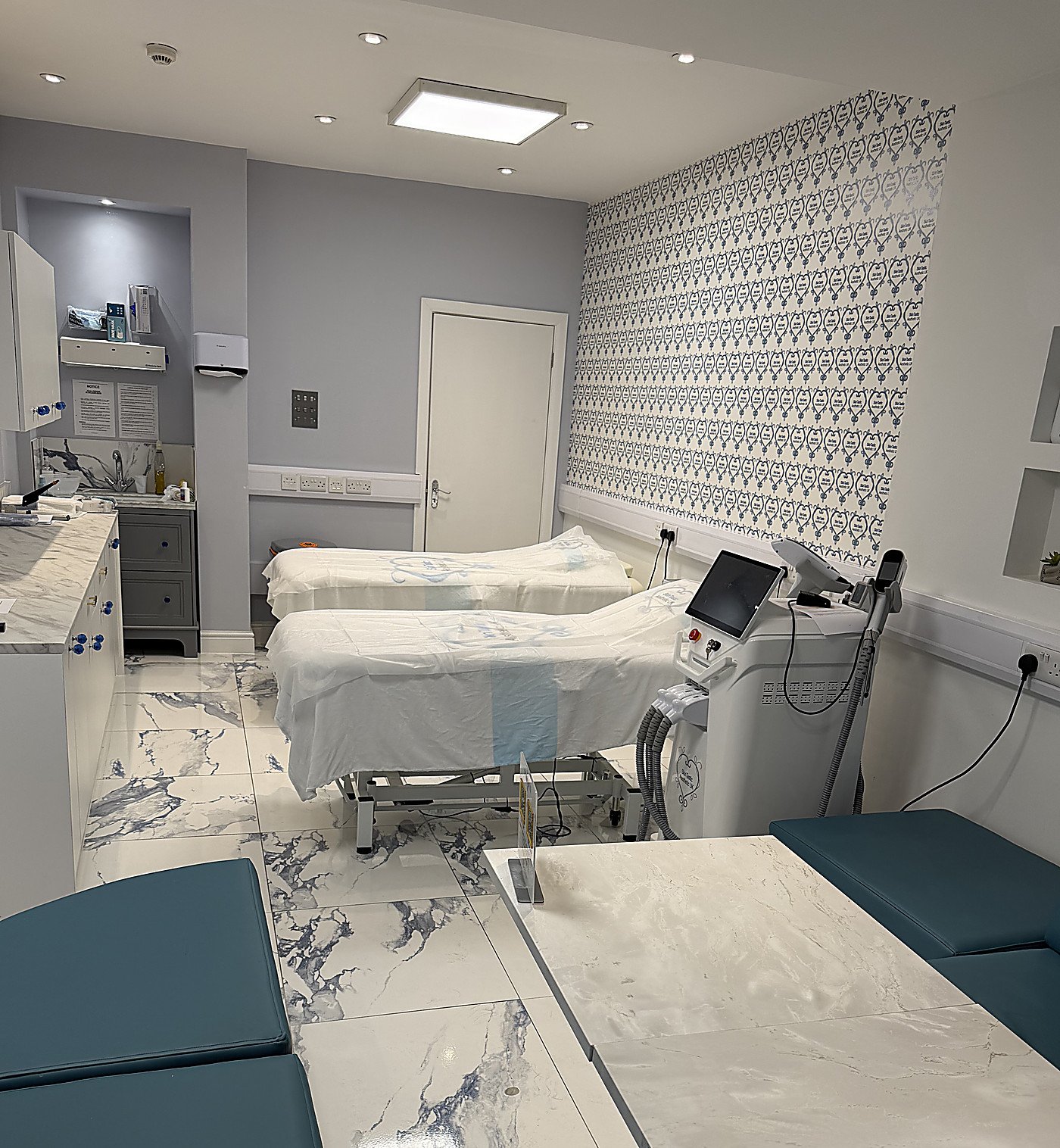
Our own laser room. One controlled entrance door, no mirrors, nothing glazed or chromed near the working area, and a clear floor.
The door and the controlled area
The treatment room is your Laser Controlled Area. It must be clearly defined, and while treatment is in progress it must not be used for anything else. Not other treatments, not preparation, not cleaning, and not as a walk-through to another room.
The door should have a lock, preferably a twist lock, that can still be opened from outside in an emergency. It protects the client’s privacy and stops somebody walking in mid-pulse, without trapping anyone.
A warning sign goes on the outside of the door while the machine is in use, and comes off or gets covered when it is not. A sign that lives there permanently stops meaning anything.
Reflective surfaces
A full 360-degree check of all four walls, including mirrors, pictures and anything glazed. Reflection is a hazard regardless of the colour of the surface, and that includes polished metal instruments and jewellery.
Choose treatment furniture that avoids highly reflective finishes, especially chrome close to the handpiece, and dull the surface of any instrument used near the beam so it reflects diffusely rather than as a beam.
Windows and other doors
Every window needs a covering, whether roller, vertical or horizontal blinds, or curtains, and the LPA records how many there are and what covers them.
Any other door leading off the room gets recorded as well: emergency exits, storage cupboards, the toilet, a shower room, a spray-tan cubicle. Each one is a way for somebody to walk into the beam.
Ventilation, ceiling and floor
Ventilation matters for plume as well as comfort: ceiling extraction, a vent, air conditioning, or an opening window. The LPA records which you have.
Ceiling and lights are photographed, and so is the floor. Visible cables and trip hazards in a room where somebody is wearing dark protective glasses are a genuine risk.
Key control
Where does the laser key live when nobody is treating? A lockable box, a till or a locked drawer, but somewhere deliberate.
Key control is one of the simplest and most effective controls you have, and it is the one most often ignored once the novelty wears off.
Fire and flammables
You need easy access to an extinguisher suitable for electrical fires, either CO₂ or water mist, and the LPA records its type, location, last check and next due date.
Fire, explosion and toxic gases can result if drapes, clothing, paper couch roll or flammable liquids meet the beam. Alcohol-based skin preparations must not be used near the machine.
“There’s one somewhere in the building” is not an answer that survives an inspection.
The paperwork your LPA will ask for, so start collecting it before delivery
The machine’s identification label and serial number, plus the yellow warning labels on the rear, all photographed
The full output specification for every applicator: wavelength, maximum energy, pulse duration and spot size
Date of last service, and the date each operator was trained on each machine
Your PAT test record for the machine, with the date
The name of your Laser Protection Supervisor and a list of every operator
Core of Knowledge certificates for each operator, with the month and year
A list of the treatments you intend to offer on each machine
An eyewear inventory covering brand, quantity, type, and which pair is for which machine
Room dimensions, which floor of the building it is on, and a rough floor plan sketch
An entrance warning sign for the door
Two things worth knowing about timing. Your Site Audit Report is dated the day the LPA receives complete information, so chasing missing specifications from a supplier delays your paperwork, not just your patience. And Local Rules and Risk Assessments are normally valid for a year and reviewed annually by the LPA and the LPS, so this is a recurring cost and a recurring task, not a one-off.
What Local Rules actually make you do, day to day
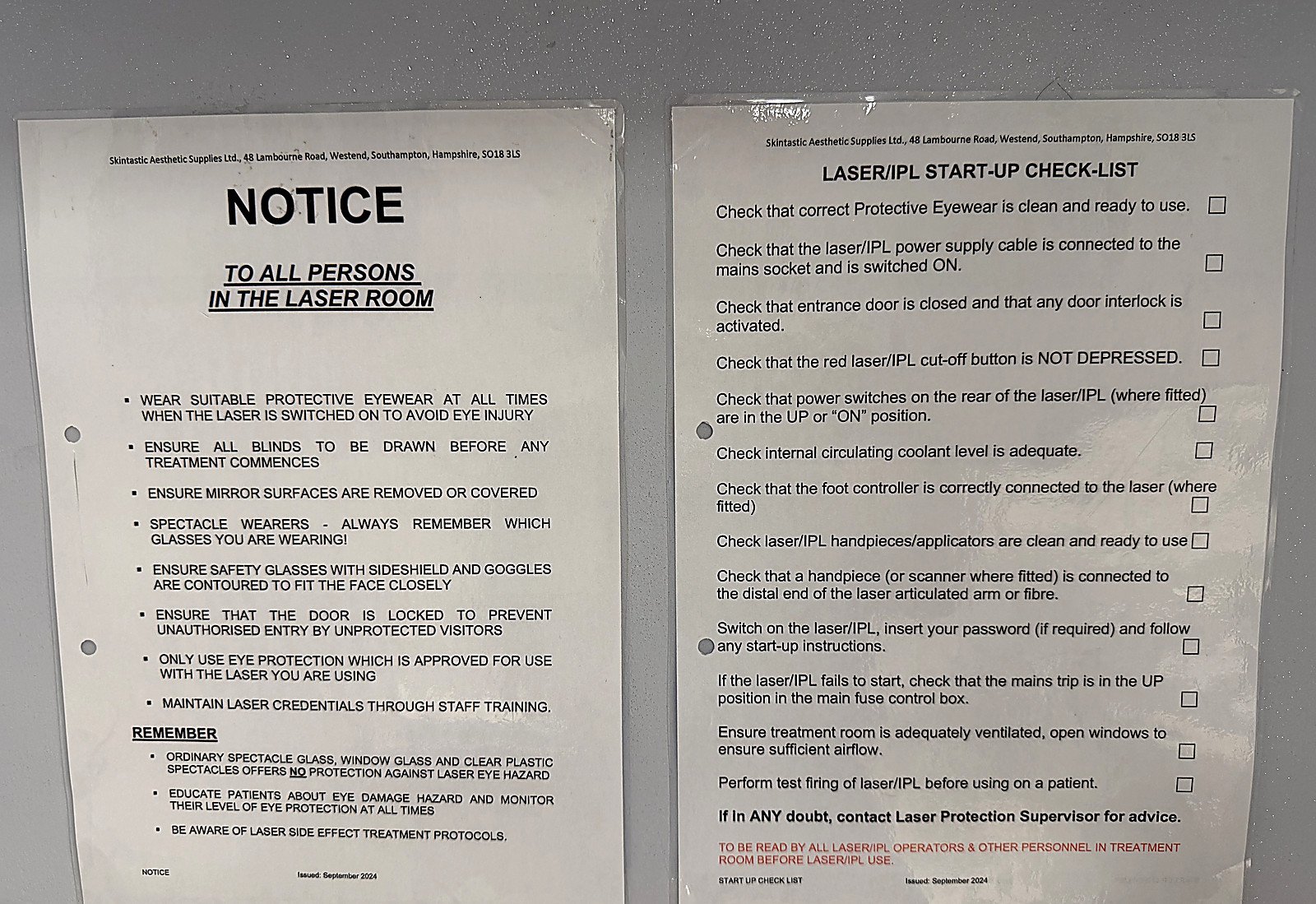
The notice and start-up checklist on our own laser room wall. Laminated, on the wall, read before every session. This is what Local Rules look like once they stop being a document in a drawer.
A treatment register
Every single time the machine is fired, recorded: the client’s name and date of birth, the date and time, the operator’s name and signature, the treatment given including the parameters used, and any accident or adverse effect. Parameters matter, because without them you cannot explain what happened if something goes wrong.
A register of authorised users
Only named, authorised people use the machine. Each one signs to say they have read and will follow the Local Rules. Adding somebody later is a deliberate act by the Laser Protection Supervisor, not a favour on a busy day.
Nobody unprotected in the room
The authorised user is responsible for everyone inside the controlled area. No second laser or IPL is used in that area at the same time, and the machine is not enabled to fire unless it is pointed at the treatment site or a test object.
Key discipline
Whenever the machine is unattended it is switched off and the key withdrawn, then stored in a lockable cabinet. Only authorised users have access to it.
Servicing and electrical testing
Serviced at least annually by a competent person, with a device history record of servicing and repairs. An electrical safety test in line with your council’s guidance, usually annually.
Core of Knowledge, refreshed
The Laser Protection Supervisor must hold a recognised Core of Knowledge certificate, and that training should be repeated every three to five years, alongside ongoing CPD reflecting new equipment and techniques.
If something goes wrong
Suspected eye exposure. An eye examination by an ophthalmically qualified physician or surgeon within 24 hours, and tell your LPA as soon as possible
A severe burn or other medical emergency. Examination by a suitable specialist within 24 hours, and again inform the LPA
Emergency shutdown. Hit the red mushroom stop button on the console, then isolate the electrical power
Report any adverse incident involving the device to the MHRA, and to the CQC or the relevant devolved regulator where that applies
Certain injuries are reportable to the HSE under RIDDOR 2013, including temporary or permanent loss of sight, electric shock causing unconsciousness, and fractures other than to fingers, thumbs and toes
Death or serious injury requiring more than three days off work must be notified to your local council, or the CQC where applicable
Know your nearest 24-hour A&E with an on-call ophthalmic specialist and plastic surgeon, and write it into your Local Rules before you need it
Eye protection
Safety glasses: the detail that gets people hurt
There is no such thing as “laser glasses”. There is only eyewear rated for particular wavelengths, at a particular strength, for a particular kind of pulse. Get that wrong and the glasses are decoration.
This is the part of a machine purchase where the paperwork stops being administrative and starts being about somebody’s sight. It is also the part suppliers are most likely to wave through with “goggles included”.
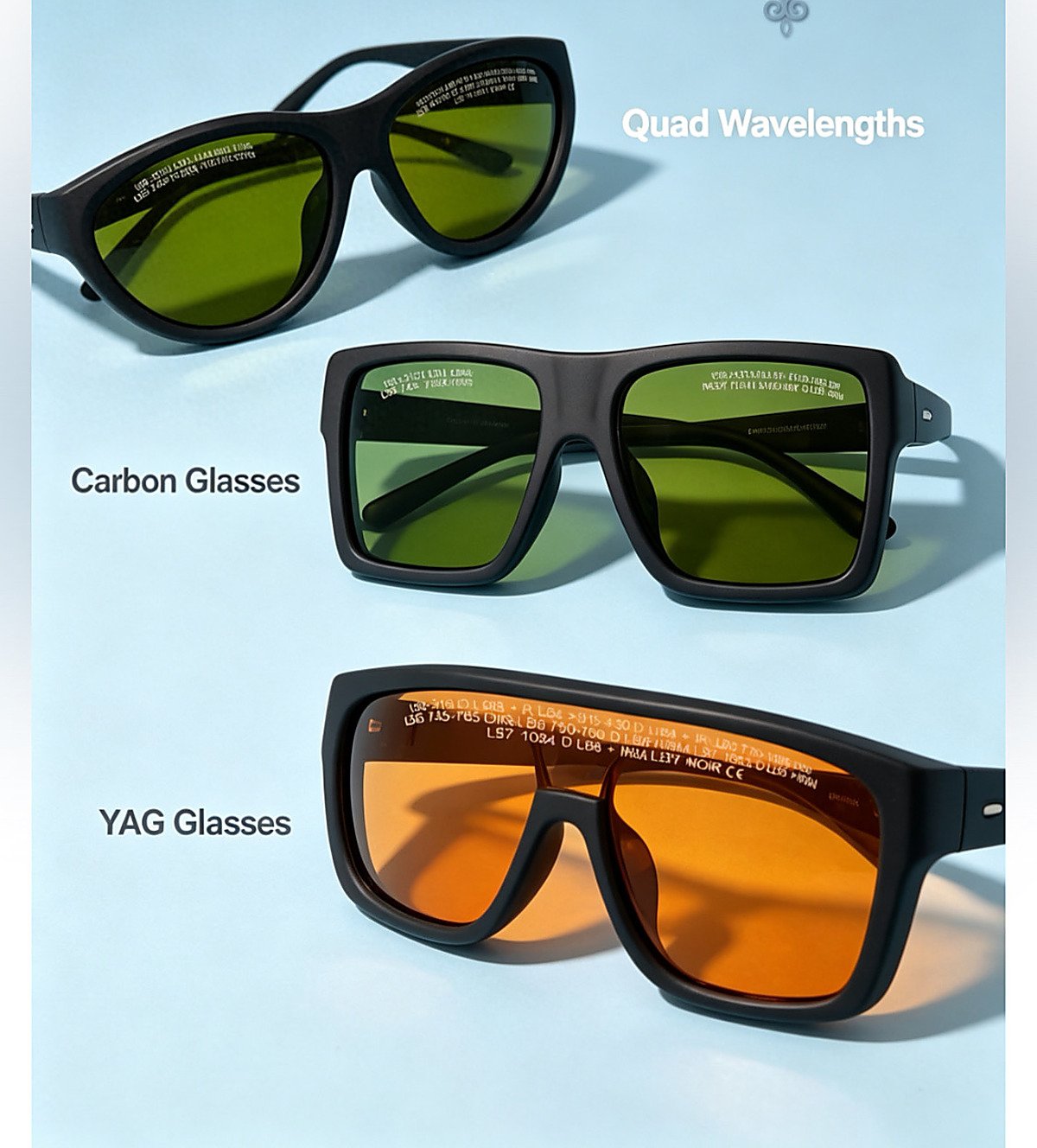
One pair of glasses does not cover a multi-wavelength machine. Nd:YAG, carbon peel and multi-wavelength platforms each need eyewear rated for the wavelengths in use, and every pair carries its own markings on the frame.
1
Every filter is wavelength-specific
A pair rated for 1320nm may offer no useful protection at all at 755nm or 532nm. On a multi-wavelength platform, with diode, Nd:YAG and IPL in one trolley, one pair of glasses cannot cover everything.
That means several pairs, each clearly marked, and a habit of checking the marking against the handpiece you are about to fire.
2
Learn to read the marking
Laser eyewear is marked with the wavelength range it covers and a protective density scale number, from LB1 up to LB10, sometimes written as an optical density.
In front of the LB number you will see a letter for the operating mode the filter is tested against: D continuous wave, I pulsed, R giant-pulsed, which is your Q-switched Nd:YAG, and M mode-locked. A marking like D LB6 IR LB8 is telling you something specific, not decorating the arm.
3
Only the manufacturer can specify it
To calculate the protection level required, you need the wavelength, the maximum output energy, the pulse duration and the spot size for every applicator on the machine.
If the supplier cannot give your Laser Protection Adviser that full specification, nobody can properly specify your eyewear. Not the LPA, not you, and not the person selling you glasses online.
The standards, and which one applies to what
Standard
What it is
When it applies
BS EN 166
Personal eye protection, specifications
The base standard covering the frame, optical class and mechanical strength. Necessary, but on its own it is general eye protection, not laser protection
BS EN 207
Laser eye-protectors
The standard for eyewear used during laser treatment. This is the one that carries the wavelength range and the LB scale number
BS EN 208
Laser adjustment eye-protectors
For alignment and adjustment work only. Not adequate protection for treating a client, and a genuine, dangerous mix-up
BS EN ISO 12609
Eyewear for intense light sources, cosmetic and medical
The correct standard for IPL. IPL eyewear is rated by shade number, not by LB scale, which is why IPL glasses and laser glasses are not interchangeable
While you are asking, ask about the machine standards too
Eyewear is not the only thing with a standard behind it. A properly documented laser or IPL system should be able to point you at BS EN 60825-1 for laser product classification, BS EN 60601-2-22 for laser equipment, and BS EN 60601-2-57 for non-laser light source equipment such as IPL. The machine’s own labels should identify it, its wavelength or wavelength range and its maximum output power, in a clearly visible place on the front or sides.
So “our glasses are CE marked to EN 166” is not the reassurance it sounds like. It tells you the frames are proper eye protection. It tells you nothing about whether the filter stops your laser. Ask for EN 207 for the laser wavelengths and EN ISO 12609 for the IPL, and ask which wavelengths and which scale numbers.
Your clients need something different again
Operator glasses protect the person holding the handpiece. When you are treating above the neck, a client needs metal ocular shields placed directly over the eyes. Ordinary goggles do not do that job, and the MHRA guidance says so. Shields and glasses are both consumables that get lost, scratched and cracked, so they need an inventory and a routine check, not a drawer.
Where the law comes in
The Personal Protective Equipment at Work Regulations 1992 require suitable PPE where risk cannot be controlled another way. The Control of Artificial Optical Radiation at Work Regulations 2010 require that protective eyewear is available and that people are trained in its proper use. The standards above are how you demonstrate that what you have is suitable. They are the evidence, not a separate rule.
A practical habit worth adopting from day one. Label each pair with the machine and the wavelengths it is for, keep a written inventory, provide a pair for every person who will be inside the controlled area, and inspect for cracks and scratches before each use. A scratched filter is a failed filter.
Core of Knowledge
The training requirement most buyers have never heard of
Core of Knowledge is the laser safety training that sits underneath everything else. It is short, it is specific, and whose certificate you hold is starting to matter.
What it is
A laser and light safety syllabus specified by the MHRA and revised in 2015. It covers the physics you actually need, the hazards, the controlled area, eyewear, and safe operating practice.
It is separate from your treatment qualifications. A Level 4 laser and IPL qualification teaches you to treat. Core of Knowledge teaches you not to hurt anybody, including yourself.
Who asks for it
It is expected by the CQC and by the devolved regulators in Wales, Northern Ireland, Scotland and the Isle of Man, and by councils operating special treatment licensing in England.
The MHRA’s own guidance points people towards obtaining it from an RPA2000-certified or ALSP-certified Laser Protection Adviser.
The bit that is changing
London councils have moved towards accepting only Ofqual-regulated Core of Knowledge courses, and at least one borough has said it will do so in future. Other councils still accept courses from certificated LPAs carrying CPD credits.
As at August 2026 there are only two Ofqual-regulated qualifications with Core of Knowledge in the title: 610/2388/7 from VTCT Skills and 610/5706/X from Qualifi. Both are Level 4 awards, and you can look either up on Ofqual’s public register.
Before you book any Core of Knowledge course, ring your council and ask what they will accept. A course can be excellent, written to the MHRA syllabus, delivered by a certificated LPA and carrying CPD credits, and still not be what your particular licensing officer wants to see. That is not a criticism of the course. It is a reason to ask first rather than pay twice.
Four nations, four answers
Where you practise changes what you must do
This is the part that catches people who read advice written for a different part of the UK.
Where
What applies to laser and IPL
England
No national registration for cosmetic laser or IPL. CQC registration is required where a registered medical practitioner uses IPL or lasers to treat disease, disorder or injury, but not for exclusively cosmetic use. Some councils require a separate registration or a special treatment licence. In the 33 London boroughs this runs under the London Local Authorities Act 1991, and licence conditions can cover operator qualifications and equipment safety. Conditions vary by council, so ask yours directly.
Wales
Class 3B and Class 4 lasers and intense light are listed services under the Independent Health Care (Wales) Regulations 2011, which makes the premises an independent hospital requiring registration with Healthcare Inspectorate Wales. HIW will not accept an application without evidence that you have engaged a Laser Protection Adviser, local rules for each machine signed by every user, and treatment protocols signed by a relevant GMC registered professional. Local rules must be reviewed at least annually by the LPA.
Northern Ireland
Class 3B and Class 4 lasers and filtered intense light are listed services under the Independent Health Care Regulations (Northern Ireland) 2005, requiring registration with RQIA. The Minimum Standards for Independent Healthcare Establishments require written confirmation of a certificated laser protection adviser renewed annually, a named person responsible on site, local rules signed by operators, and a defined controlled area.
Scotland
Healthcare Improvement Scotland registration has historically only captured clinics where services are provided by listed healthcare professionals. That is changing. See the section on what is coming.
Enforcement of the workplace optical radiation rules for a beauty or aesthetic clinic normally sits with your local authority rather than the Health and Safety Executive.
Training
Ofqual regulated and CPD accredited are not the same thing
Both are legitimate. They are simply different, and the difference matters to insurers and licensing officers.
An Ofqual regulated qualification
Ofqual is a government department that regulates awarding organisations in England under the Apprenticeships, Skills, Children and Learning Act 2009. A regulated qualification is designed and awarded by a recognised awarding organisation, sits on the Regulated Qualifications Framework at a stated level, and is externally assessed and quality assured.
Every regulated qualification has a number in the format 603/3322/4. You can look that number up free on Ofqual’s public register and see the awarding organisation, the level and whether it is still being awarded.
Levels mean difficulty, not length. Level 4 is broadly the first year of higher education; Level 5 broadly the second. Two qualifications at the same level can differ enormously in hours.
A CPD accredited course
CPD accreditation is independent third-party review that a course is well structured and delivers meaningful learning. It is a real and useful thing, and most practitioners add new treatments this way.
It is not an Ofqual regulated qualification, and CPD accreditors are private companies, not government regulators. There is no public register you can check a CPD certificate against, only the accreditor and the provider.
So a CPD certificate evidences that training was delivered and independently reviewed. A regulated qualification evidences externally assessed competence against a national standard that anyone can verify.
Three checks worth doing on any training that comes with a machine
Ask for the qualification number and look it up yourself on Ofqual’s register. If there is no number, it is not a regulated qualification, whatever the certificate looks like
Check the qualification is still available to learners rather than withdrawn. A certificate can be genuine, regulated and still be from a qualification that is no longer awarded
Remember that approved centre status is granted by the awarding organisation, not by Ofqual. Ofqual does not list training centres, so verify centre approval with the awarding organisation directly
Watch the wording rather than the logo. There is a recognised awarding organisation called Laser Learning Awards whose qualifications are in social care, youth work and first aid. A certificate reading “LASER Level 3 Award in…” is not laser training.
Due diligence
Checking the company, not just the machine
Every check below is free, public, and takes less time than reading a brochure.
1
Companies House
Search the company name at Companies House. You get the incorporation date, the filing history, the accounts, the officers, previous company names, charges over assets and any insolvency entry. Dissolved companies are searchable too.
What to look for: an incorporation date far more recent than the “established” claim in the marketing; repeated late filings; dormant or micro-entity accounts under a company claiming serious turnover; or a brand-new company at the same address as one that was recently dissolved.
2
VAT registration
HMRC has a free checker for UK VAT numbers. It returns the name and address the number is registered to, so you can confirm the number belongs to the business you are dealing with rather than simply being valid.
If you are VAT registered yourself, the service will also give you a dated record proving when you checked. Keep it with the purchase file.
3
Trade marks
The Intellectual Property Office register tells you who actually owns a brand name. It is a quick way to see whether the supplier owns the machine brand or is reselling somebody else’s.
4
MHRA device register
If the machine is a medical device, find it on the MHRA’s Public Access Registration Database and confirm the manufacturer and the UK Responsible Person match what you have been told.
5
FCA register
Anyone who arranges finance for you should appear on the FCA’s Financial Services Register. Check the status is current and that the permissions cover what they are actually doing.
6
Insurance
There is no public register of a supplier’s product liability cover. Ask for the certificate, check the insurer named on it, and verify that insurer or broker on the FCA register.
Our own rule of thumb, offered as opinion rather than law: we would want a supplier to have been trading for at least five years and to be VAT registered before we handed over five figures. Neither is a legal requirement, and a good new business has to start somewhere. But a long filing history and a verifiable VAT number tell you there is a real trading company behind the invoice, and that someone will still be answering the phone when a handpiece fails in year three.
Finance
One thing almost nobody tells you about equipment finance
If you are a sole trader borrowing under £25,000, you probably have more protection than you have been led to believe.
Whether a credit agreement is regulated turns on two things: who is borrowing, and how much.
Who is borrowing
A limited company borrowing is never a regulated consumer credit agreement. A sole trader, or a partnership of two or three people not all of which are companies, can be.
How much
The business-purpose exemption only applies if the credit exceeds £25,000and the borrowing is wholly or predominantly for business. Both limbs are required.
What that means in practice
A sole trader financing a £20,000 laser for their clinic is below the threshold, so the agreement is a regulated consumer credit agreement, with an affordability assessment and access to the Financial Ombudsman Service.
You may be asked to sign a business purpose declaration. It creates a presumption that the borrowing is for business, and it acknowledges that you are giving up consumer credit protections. Read it before you sign. Signing it does not by itself take a sub-£25,000 agreement outside regulation, because the amount is a separate requirement. This area is also moving: HM Treasury set out its final approach to reforming the Consumer Credit Act in May 2026.
What is coming
Changes to plan for, not to panic about
If you are buying a machine you expect to keep for seven years, these matter more than this month’s discount.
1
Scotland: a licence from 6 September 2027
The Non-surgical Procedures and Functions of Medical Reviewers (Scotland) Act 2026 received Royal Assent in May 2026, and a Civic Government (Scotland) Act order made in February 2026 designates non-surgical procedures as a licensable activity.
Non-ablative laser and light treatment, which covers laser and IPL hair removal, pigmentation, vascular work and skin rejuvenation, will need a local authority licence from 6 September 2027, unless the clinic is HIS registered under a prescribing clinician. Ablative laser treatment will be confined to those registered premises, and there will be an under-18 prohibition on specified procedures.
2
England: still waiting
Section 180 of the Health and Care Act 2022 gives ministers the power to create a licensing scheme for cosmetic procedures in England. The Government published its consultation response in August 2025 and said it would consult further on the highest risk procedures.
As at August 2026 no scheme is in force. When it arrives it will come through secondary legislation, and it is likely to be run by local authorities.
3
Cosmetic devices may come into scope
The Government has said it intends to extend Great Britain’s medical device rules to products without a medical purpose, naming cosmetic lasers and IPL equipment.
No instrument, no date. If it happens, cosmetic-only machines would face conformity assessment and registration requirements they do not face today, so it is worth asking a supplier how they would handle that for a machine you buy now.
4
CE recognition after 2028 and 2030
A consultation on recognising CE marked devices indefinitely closed in April 2026 with no published outcome. Until it reports, plan around 30 June 2028 for MDD certificates and 30 June 2030 for MDR certificates.
The short version
Twelve things to ask before you pay a deposit
1
Is this machine a medical device? If yes, what class?
2
May I see the declaration of conformity naming this exact model?
3
May I see the UK Approved Body or Notified Body certificate, not an EMC, RoHS or FDA report?
4
Was it certified under the EU directives or under the EU MDR? Which deadline applies?
5
Who is the UK Responsible Person, and may I see the letter of designation?
6
What is the MHRA registration entry, so I can find it on the public database myself?
7
Which eyewear comes with it, and what wavelengths and scale numbers does it cover?
8
What training is included, a regulated qualification with a number, or CPD?
9
What does my council require: LPA, local rules, treatment protocol, which Core of Knowledge?
10
Are the labelling and instructions for use in English, and what is the warranty?
11
What do consumables cost, and how quickly can you supply them?
12
How long has your company traded, and what is your VAT number?
Any decent supplier will welcome these questions. The ones who bristle are telling you something useful, free of charge.
Common questions
Questions buyers ask us most
The short answers. Each one is covered in more detail in the sections above.
Does an aesthetic laser or IPL machine have to be registered with the MHRA?
Only if it is a medical device. Where it is, the manufacturer, or its UK Responsible Person where the manufacturer sits outside the UK, must register it with the MHRA before it is placed on the Great Britain market. Registration is a notification, not an approval. It does not certify the individual machine you are buying, and it says nothing about how that unit has been stored, refurbished or serviced.
What does a UK Responsible Person actually do?
A UK Responsible Person is appointed by an overseas manufacturer and is legally accountable for that manufacturer’s obligations in the UK under the Medical Devices Regulations 2002. They hold the declaration of conformity and technical file for the MHRA, cooperate on corrective action, pass complaints and suspected adverse incidents back to the manufacturer, and can be prosecuted as the person who placed the device on the market. You do not appoint one. You check that one exists and that the machine you are buying is registered under it.
Is a CE mark enough when buying a laser in the UK?
No. A CE mark tells you the product satisfied a European route. It does not tell you which side of the UK medical device line the product sits on, and it is not a substitute for asking. Great Britain still accepts CE marked medical devices, but not indefinitely, and the deadline depends on which European rules the certificate was issued under. Ask which regime the machine was certified under and when that certificate expires.
Do I legally need a Laser Protection Adviser?
There is no Great Britain-wide law requiring a private aesthetic clinic to appoint a Laser Protection Adviser. The MHRA calls it good practice. It becomes compulsory through registration or licensing: Healthcare Inspectorate Wales will not accept a registration without evidence that you have engaged one, Northern Ireland’s minimum standards require written confirmation of a certificated adviser renewed annually, and many English councils that operate special treatment licensing expect one.
Do I need a licence to use a laser or IPL?
It depends where you practise. England has no national registration for cosmetic laser or IPL, but some councils require a separate registration or a special treatment licence, which in the 33 London boroughs runs under the London Local Authorities Act 1991. Wales requires registration with Healthcare Inspectorate Wales, and Northern Ireland with RQIA. Conditions vary by council, so ask yours directly and get the answer in writing.
What standard should laser safety glasses meet?
BS EN 166 is the base standard covering the frame, optical class and mechanical strength, but on its own it is general eye protection rather than laser protection. BS EN 207 is the standard for eye-protectors used during laser treatment, and it is the one that carries the wavelength range and the LB scale number. BS EN 208 covers alignment and adjustment work only and is not adequate protection for treating a client.
What is Core of Knowledge training, and is it a legal requirement?
Core of Knowledge is a laser and light safety syllabus specified by the MHRA and revised in 2015, covering the physics, the hazards, the controlled area, eyewear and safe operating practice. It is separate from your treatment qualifications. It is expected by the CQC, by the devolved regulators, and by councils operating special treatment licensing in England. As at August 2026 there are only two Ofqual-regulated qualifications with Core of Knowledge in the title, and some councils now accept only those, so ring your council before you book.
What is the difference between an Ofqual regulated qualification and a CPD accredited course?
Both are legitimate, but they evidence different things. An Ofqual regulated qualification is awarded by a recognised awarding organisation, sits on the Regulated Qualifications Framework at a stated level, is externally assessed, and carries a number in the format 603/3322/4 that anyone can look up free on Ofqual’s public register. CPD accreditation is independent third-party review that a course is well structured, carried out by private companies rather than a government regulator, and there is no public register to check a CPD certificate against.
Sources
Check this for yourself
We would rather you verified this than took our word for it. These are the primary sources behind the page.
Financial Services and Markets Act 2000 (Regulated Activities) Order 2001, article 60C : legislation.gov.uk
Last checked August 2026. This is a plain-English summary written to help you ask better questions. It is not legal advice, and we are not a regulator. Rules change, and the position in Scotland in particular is changing. Check the sources above, and take your own advice before you commit.
Ask us the awkward questions
We would rather spend twenty minutes on the phone than sell you a machine that turns out to be wrong for your premises, your council or your insurance. If you are buying from someone else, you are still welcome to ring and ask what to check. We will tell you.
Every machine we supply comes with its documentation, its training, and a UK company that answers the phone. Come and see them running at The Avenue, or ask for a video demonstration.
SkinTastic Aesthetics Southampton 26 The Avenue Southampton SO17 1XL