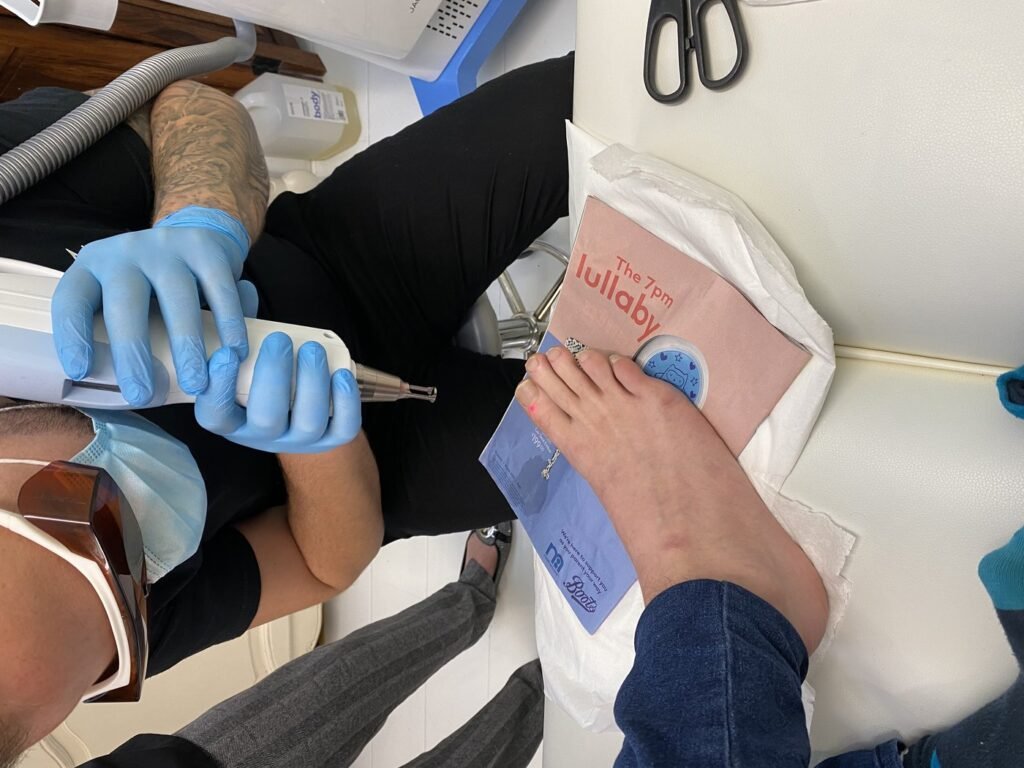
Laser fungal nail treatment, Southampton
Laser Fungal Nail Treatment Southampton
Advanced 1064nm and 532nm Nd:YAG treatment for fungal nails
Are your toenails becoming thickened, discoloured, brittle or difficult to manage? Fungal nail infection – medically known as onychomycosis – can be extremely persistent. Topical treatments can struggle to penetrate the nail plate effectively, while some clients may be unsuitable for, or prefer not to use, prolonged oral antifungal medication. Laser provides a non-invasive option designed to deliver controlled energy through the nail plate and into the affected nail and nail bed.
- 1064nm and 532nm Nd:YAG
- Medical-grade laser equipment
- MHRA-registered medical device
- No injections
- No surgical nail removal
- One hand or foot to a full set
- Approximately 2–4+ treatments
- Usually around 4 weeks apart
- Over 15 years’ laser experience
- Level 5 practitioner
- Clients aged 18+ only
From £99 per treatment
Full nail assessment required before treatment begins
- Over 15 years’ laser experience
- Level 5 qualified laser practitioner
- UK Responsible Person, MHRA
- Medical-grade Nd:YAG technology
- Individual nail assessment
- Clear medical and podiatry referral pathways
Fungal nail treatment requires more than simply firing a laser at a toenail. Not every thick, yellow or damaged nail is fungal, and where the diagnosis is uncertain we would rather refer you for proper assessment than treat the wrong condition.
The condition
What is fungal nail infection?
Fungal nail infection, also known as onychomycosis, occurs when fungal organisms infect the nail plate, nail bed or surrounding structures.
Toenails are particularly commonly affected because fungi thrive in warm, moist environments – shoes, socks, changing rooms, communal showers and swimming facilities. Fungal nail infection can affect one nail or spread across several, and without treatment it can sometimes persist for years.
What fungal nail can look like
- Yellow nails
- White areas within the nail
- Brown discolouration
- Thickened nails
- Brittle nails
- Crumbling nail edges
- Distorted nail growth
- Debris underneath the nail
- Nails separating from the nail bed
- More than one nail gradually becoming affected
But not every yellow nail is fungal
Trauma, psoriasis, repeated pressure, inflammatory nail conditions, certain medications and other medical problems can all resemble fungal infection.
If we are uncertain whether your nail changes are fungal, we may recommend medical or podiatry assessment, or fungal testing, before commencing laser treatment. Laser treatment should not replace appropriate medical diagnosis where there is uncertainty.
How it works
How laser fungal nail treatment works
Our treatment uses Nd:YAG laser energy delivered through the nail plate, into the affected nail and underlying nail bed where fungal organisms may be present.
Unlike a topical cream or lacquer, laser energy does not need to physically soak through the nail in the same way. The treatment works by creating controlled thermal and photomechanical effects within the target area.
Why we use 1064nm
1064nm Nd:YAG is one of the most widely studied laser wavelengths for fungal nail treatment. It penetrates through the nail plate and has been investigated for its ability to create controlled effects within the infected nail and nail bed.
Published research involving 1064nm Nd:YAG has reported improvements in fungal nail infection, although treatment responses vary considerably between clients.
Why we also use 532nm
Our system also provides 532nm Nd:YAG technology. Published clinical research has investigated protocols using combined 1064nm and 532nm Q-switched Nd:YAG wavelengths for onychomycosis.
The two wavelengths interact differently with tissue and chromophores. Where appropriate within our device protocol, both may form part of your treatment programme.
Your treatment is always performed according to
- Nail condition
- Number of affected nails
- Nail thickness
- Individual response
- Device protocol
- Practitioner assessment
An honest answer
Does laser kill nail fungus?
Laser treatment is intended to help reduce fungal activity within suitable infected nails and support the growth of a healthier-looking nail.
However, no responsible clinic should promise that every fungal nail infection will be permanently eradicated. Fungal nail infections can be extremely persistent, and reinfection is possible.
Results are influenced by
- Severity of infection
- Type of fungal organism
- Nail thickness
- Duration of infection
- Number of nails affected
- Foot hygiene
- Reinfection
- General health
- Nail growth rate
- Compliance with aftercare
For this reason we describe the service as professional laser fungal nail treatment rather than guaranteeing a permanent cure. Scientific research into laser treatment for onychomycosis has produced encouraging but variable results: some studies have reported strong fungal clearance, others more modest outcomes. That is why we do not advertise a guaranteed percentage cure.
Your programme
How many treatments, and how often
Approximately 2–4+ treatments
Most clients require a course rather than one treatment. Some mild infections may respond with fewer. More established, thickened or widespread infections may require additional sessions. Your progress is reviewed throughout.
Usually around 4 weeks apart
This is consistent with treatment intervals commonly used in published Nd:YAG fungal-nail protocols. The exact interval may vary according to nail response, severity, number of nails affected, skin condition, practitioner assessment and manufacturer guidance.
Laser treatment takes minutes. Healthy nail growth takes months. Laser does not instantly replace the damaged nail with a new healthy one. Even where fungal activity is successfully reduced, the damaged portion of nail must still grow out naturally – and toenails grow slowly.
How long does a toenail take to grow?
Depending on the individual and which toe is affected, complete toenail replacement can take approximately 9 to 18 months. You may begin seeing clearer nail growth from the base while the older damaged nail remains visible towards the tip. Do not judge the success of treatment purely by how the old nail looks immediately after laser treatment.
Prices
Fungal nail treatment prices, Southampton
| Treatment | Per session |
|---|---|
| One hand or one foot, all nails on that side | £99 |
| Full set, both hands or both feet | £150 |
| Consultation and patch test | £10 |
We do not treat single nails. Fungal infection spreads easily between neighbouring nails through sweat, footwear and shared tools, and a nail can be infected before any change is visible, so all the nails on the hand or foot are treated together. Courses of four are available, ask at your assessment.
Should all toenails be treated?
That depends on what we find at assessment. Fungal infection can spread between nails, so if several appear affected it may be appropriate to treat the wider group rather than only the nail that looks worst. We assess which nails are visibly affected, whether neighbouring nails appear involved, severity, nail thickness and the condition of the surrounding skin before deciding.
Your appointment
What happens during treatment
1
Nail assessment
We examine nail colour, thickness, texture, the number of nails involved, the extent of visible involvement, the surrounding skin, previous treatments and your medical history.
2
Nail preparation
Nails must be clean and free from varnish, gel polish, acrylic, builder gel and false nails. Excessively thick nails may benefit from professional reduction or filing beforehand where appropriate.
3
Laser treatment
Controlled 1064nm and/or 532nm Nd:YAG energy is delivered according to the treatment protocol, systematically treating the nail plate and treatment area.
4
Treatment response
Your practitioner monitors nail response, heat, skin response and your comfort throughout the procedure.
5
Aftercare
You receive instructions on reducing the risk of reinfection and caring for your feet throughout your treatment programme.
6
Clinical photographs
We may take standardised photographs during your programme. Because toenails grow so slowly, comparing images over several months makes gradual improvement far easier to recognise.
What to expect
Comfort, downtime and the nail itself
Does it hurt?
Most clients tolerate treatment well. You may experience warmth, increasing heat within the nail, brief hot sensations or mild discomfort. The nail can become warm during treatment.
Treatment should not simply continue through excessive pain. Your comfort and tissue response are monitored throughout the appointment.
Is there downtime?
There is generally very little downtime following Nd:YAG fungal nail treatment, and most clients return to their usual daily activities immediately afterwards. You will still need to follow appropriate hygiene and reinfection-prevention advice.
Do I need the nail removed?
No. Laser treatment does not normally require surgical removal of the nail – the energy is delivered through the existing nail plate.
However, very thickened nails may benefit from appropriate professional reduction beforehand to help optimise access to the affected nail.
Why nail reduction may help
Severely thickened fungal nails create a substantial physical barrier. Reducing excessive thickness can improve treatment access, reduce pressure, make the nail easier to manage and improve topical treatment penetration where used.
Where substantial reduction is required, we may recommend appropriate podiatry care.
Reinfection
Why fungal nail comes back, and how to prevent it
Treatment does not end when you leave the clinic. Even after successful treatment, reinfection is possible.
Fungal organisms can remain in shoes, socks, bathrooms, nail tools, communal changing areas and in athlete’s foot infections. Treatment therefore needs to be combined with good foot hygiene.
Preventing reinfection
- Keep feet clean and dry
- Dry carefully between the toes
- Change socks regularly
- Avoid repeatedly wearing damp footwear
- Allow shoes to dry properly
- Rotate footwear where practical
- Avoid sharing nail clippers
- Clean personal nail tools appropriately
- Wear suitable footwear in communal changing areas
- Manage athlete’s foot promptly
- Do not share shoes or socks
Fungal nail and athlete’s foot
Athlete’s foot and fungal nail infection can occur together. If fungal infection remains on the skin between the toes, the nails may become reinfected.
If you have itching, scaling, cracking or peeling between the toes, you may also need appropriate treatment for athlete’s foot. A pharmacist, GP or podiatrist can advise you on suitable antifungal medication.
Fungal organisms can survive within footwear. Repeatedly putting treated feet back into contaminated shoes can contribute to reinfection. During your treatment programme, consider rotating shoes, allowing footwear to dry completely, using appropriate shoe-hygiene measures and wearing fresh socks daily.
Nail products
Polish, pedicures and nail salons
Nail polish must be removed
Varnish, gel polish and artificial nail products make assessment more difficult. Before your appointment, all cosmetic nail coatings must be completely removed – nail polish, gel polish, acrylic, builder gel and false nails.
We need to be able to see and access the natural nail.
Can I have a pedicure?
Care needs to be taken with nail tools and cross-contamination. If you attend a nail salon while undergoing fungal nail treatment, tell them you have or have recently been treated for a suspected fungal nail infection.
Any instruments contacting affected nails should be appropriately sterilised or single use.
Medication
Can I use antifungal treatment as well?
Potentially. Research has investigated laser treatment combined with topical antifungal therapy, and systematic reviews have found combination treatment can outperform topical therapy alone in some studies.
If you are already using a prescribed or pharmacy antifungal treatment, tell us during consultation. Do not stop prescribed medication simply because you are having laser treatment. Your GP, pharmacist or podiatrist should advise you regarding medicinal antifungal treatment.
Can my GP test for fungal nail?
Yes. Where diagnosis is uncertain, a GP or appropriate healthcare professional may arrange testing such as a nail clipping or scraping for laboratory analysis, which can help establish whether fungal organisms are present.
Safety
When laser treatment is not suitable
Laser treatment is not automatically suitable for every client, and nail problems in some groups require particular caution.
Diabetic clients
Diabetes can affect circulation, sensation, wound healing and infection risk. If you have diabetes this must be disclosed during consultation.
Depending on your medical history, circulation and nail condition, we may require appropriate medical or podiatry assessment before laser treatment.
Circulation problems
Healthy circulation contributes to tissue health and nail growth. Clients with known peripheral vascular disease, significant circulation problems, neuropathy or poor wound healing require careful assessment.
We may postpone or decline treatment where there is
- Active bacterial infection
- Open wounds
- Ulceration
- Significant inflammation
- Unexplained nail changes
- Suspicion of another nail disorder
- Significant circulation problems
- Poorly controlled medical conditions
- Medication contraindicating treatment
- Another contraindication identified at consultation
We would rather recommend medical or podiatry assessment than laser a nail when the diagnosis is uncertain. Treatment is available to clients aged 18 and over only.
Before and after
Preparing for treatment, and afterwards
Before your appointment
- Remove all nail varnish and gel polish
- Remove acrylic, builder gel and false nails
- Trim excessively long nails appropriately
- Wash and dry feet thoroughly
- Bring clean socks
- Tell us about medication
- Tell us about diabetes
- Tell us about circulation problems
- Tell us about previous fungal treatment
After your treatment
- Keep feet clean and dry
- Wear clean socks
- Allow shoes to dry
- Avoid sharing nail tools
- Continue antifungal treatment where medically advised
- Manage athlete’s foot if present
- Follow all personalised aftercare instructions
- Attend your next treatment at the recommended interval
The most important sign of progress is new, healthier-looking nail growing from the base. The old damaged part of the nail does not become new nail tissue – instead, healthier nail gradually grows forward while the damaged portion is trimmed away over time. This process takes patience.
Why us
Why choose Skintastic for fungal nail laser treatment
- Over 15 years’ laser experience
- Level 5 qualified laser practitioner
- Professional medical-laser training academy
- Qualified assessor and IQA in advanced medical laser education
- UK Responsible Person for medical devices, MHRA
- Medical-grade Nd:YAG technology
- 1064nm and 532nm treatment wavelengths
- MHRA-registered medical device
- Individual nail assessment
- Professional laser safety protocols
- Clear referral pathways where medical or podiatry assessment is more appropriate
FAQ
Frequently asked questions
What is fungal nail infection?
Fungal nail infection, or onychomycosis, is a fungal infection involving the nail plate, nail bed or surrounding nail structures.
What laser do you use?
Professional Nd:YAG technology incorporating 1064nm and 532nm wavelengths, used according to our treatment protocol.
Does 1064nm work for fungal nails?
1064nm Nd:YAG is one of the most widely studied laser technologies for onychomycosis. Published studies have reported improvement and fungal clearance, although results vary.
Why use 532nm as well?
Published research has also investigated combined 1064nm and 532nm Q-switched Nd:YAG protocols for fungal nail treatment. Our treatment is performed according to our device protocol and individual assessment.
How many treatments do I need?
Approximately two to four or more, depending on the severity of infection.
How long between treatments?
Typically around four weeks, although this can be adjusted according to individual response and protocol.
Can I have just one nail treated?
No. We treat all the nails on the affected hand or foot together, because fungal infection can spread to neighbouring nails before it is visible.
How much is one hand or one foot?
£99 per treatment for all the nails on that side. Courses of four are available.
How much is a full set?
£150 per treatment for both hands or both feet.
Does laser permanently cure fungal nail?
We cannot guarantee permanent cure or eradication. Fungal nail infections can recur or become reinfected.
Will my nail look normal immediately afterwards?
No. The damaged nail needs to grow out naturally, with healthy-looking new nail gradually growing from the base.
How long does a toenail take to grow?
Complete toenail replacement can take approximately 9 to 18 months, depending on the nail and the individual.
Does fungal nail laser hurt?
You may experience warmth or short periods of heat within the nail. Treatment is generally well tolerated, and your comfort is monitored throughout.
Is there downtime?
Usually very little. Most clients return to their normal activities immediately.
Do I need to remove nail polish?
Yes. All polish, gel, acrylic and other coatings must be completely removed before treatment.
Should I treat athlete’s foot as well?
If athlete’s foot is present, appropriate antifungal management is important, because untreated fungal skin infection can contribute to reinfection of the nails.
Can I use antifungal medication with laser?
Potentially. Published evidence suggests combining laser with topical antifungal treatment may be beneficial in some cases. Medication should be discussed with your GP, pharmacist or podiatrist.
Can diabetics have laser fungal nail treatment?
Diabetic clients require individual assessment because circulation, neuropathy and healing can be affected. Medical or podiatry clearance may sometimes be required.
Can you diagnose fungal nail?
We can assess whether the appearance seems compatible with fungal nail infection, but not every abnormal nail is fungal. Where the diagnosis is uncertain we may recommend medical or podiatry assessment and fungal testing.
Can I have treatment if the skin is infected or broken?
No. Active infection, ulceration, wounds or significant inflammation may require medical treatment before laser is considered.
Can you treat fingernails?
Yes. Fingernails are priced the same way as toenails: £99 for one hand, £150 for both.
Do you guarantee eradication?
No. We provide professional laser treatment intended to reduce fungal activity and support healthier nail growth, but no responsible provider should guarantee permanent eradication.
What age do I need to be?
You must be 18 or older. We cannot treat under-18s due to our insurance requirements.
Book your fungal nail consultation in Southampton
Fungal nail infection can be stubborn, and it takes patience – even once fungal activity has been reduced, a damaged toenail must still gradually grow out.
Our approach combines professional nail assessment, 1064nm and 532nm Nd:YAG technology, appropriate treatment intervals, reinfection-prevention advice and long-term monitoring of healthy nail growth into an individual treatment programme.
If you have discoloured, thickened or damaged nails, the first step is assessing whether they appear suitable for laser treatment. If we believe the presentation requires medical or podiatry assessment rather than cosmetic laser treatment, we will tell you.
One hand or foot £99. Full set £150. Courses of four available. Single nails are not treated.
SkinTastic Aesthetics Southampton
26 The Avenue
Southampton
SO17 1XL
Telephone: 02381 946394
Real Client Results